Road To Perdition
Road to Perdition is a masterclass in cinematography and acting directed by Sam Mendes in 2002. Produced by Fox and making a gross of $104,054,514. Featuring Oscar winning actors such as Tom Hanks and Paul Newman this film captivated audiences and really stretched the general conventions of a gangster film. With the cinematographer of this film being no other than Conrad Hall this film was bound to be a success. Many reasons for it's success was down to the breathtaking use of lighting and eerie underscore.
This screenshot gives a perfect example of how shadows and lighting was used in this film. With the film being set in the 1930's, Mendes played around with the Film Noir feel, incorporating it in many shots. With the characters at the bottom of the shot mere silhouettes this gives connotations that they don't want their identities to be shown. Furthermore with the diegetic light coming from the street lamp this draws our focus on the characters in the fore ground, Also, with their being little to no lighting in the scene it gives the audience a sense of scepticism as they are unsure as whats going to happen. The dark night setting gives connotations of mystery and betrayal. The camerawork in this screenshot is fabulous, Hall has used a long wide shot slowly panning upwards displaying the whole street, this is effective because it shows how desolate the streets are. This leads the audience to believe that the men in the shot are of importance or are well known as they are the only people in the whole street, as if no-one wants to be involved with them. The soundscape in this sequence also adds to the effect in the scene, for example the eerie, crescendo underscore partnered with the sound of rain slapping against the road compliments the anticipation created within the scene. These are all common conventions with the thriller genre and more specifically gangster films. The camerawork in this seen gives the feel that we are following the men towards to the car, as if someone is watching them. Also, the fact that there is no-one else in the shot of the whole street except Newman and his cronies could be interpreted as a metaphor for the power and dominance he has.
In this screenshot a clear sense of power is displayed where Paul Newman is walking along in the road surrounded by his men. The fact that it is a relatively low angle mid shot suggests that he has a lot of power and is above the others around him. In addition to this the mise en scene of this sequence is very conventional of Film Noir. For example, the long coats and flat caps are a common feature in most old school gangster films. The rule of thirds is used extremely well in this composition as the main character at the head of the group is on the right side, This draws our attention to him drawing our eye and encouraging the audience to look really observe and understand the characters power. To add to this the deep focus is on the character at the front of the group showing his dominant role.
In the next shot we see an over the shoulder shot displaying a dead man in a car which then switches to a reverse shot of Rooney's expression from inside the car. This piece of camerawork is very clever as displays the characters monotone facial expression instigating to the audience that he has seen death before and is a cold man because any normal person would be shocked or horrified. However, Rooney just looks at the body then turns and looks around him as if nothing had even happened. The score in this sequence is very effective as it is very loud and almost soothing. This contrasts what is happening in the scene as you would expect it to be more fast paced music instigating panic but the soundscape remains calm. Furthermore, the sound of rain cuts out in this shot to make the viewer focus solely the camerawork and plot.
In this next sequence we see the character Rooney turn around and then it cuts to a captivating POV shot. This shot puts us in the shoes of the character instigating a sense of panic as he scans the area for the drivers killer. All we see in the POV shot is buildings consumed by shadows and the dimly lit floor being splattered by rain. This is done for effect as it adds a sense of mystery to the sequence where the viewer and the character both are in the same position, looking for the perpetrator. The low lighting in the scene and the POV shots mixes together to create a panic feeling causing the audience and the character feel a sense of vulnerability.
In the next sequence we see Rooney's henchmen being gunned down from in the shadows, all the audience see is the muzzle flash from the Tommy Gun and his men dropping dead.The use of a low angle mid shot is very beneficial in depicting what is happening in the scene as it gives a view on the panic that is created when the bullets are being fired. To add to this sense of panic Mendes has introduced a louder more frantic piece of music in the background, this perfectly fits with what is happening in the scene as it instigates even more panic. The effectiveness of the prior eerie slow music really comes into play when there is a change in tempo and volume because it shows the change in attitudes of Rooney as a character. He came into the scene confident surrounded by his henchmen, but when the shooting starts and the music gets louder the atmosphere flips completely.
In conclusion the sequence grabs the attention of the audience through various ways. The use of shadows and silence is incredibly important in building tension and mystery within the film. The mise en scene is fairly simple and fits in with the general conventions from a typical Film Noir.
Showing posts with label G321 Thriller Research. Show all posts
Wednesday, 22 February 2017
Tuesday, 21 February 2017
Camerawork in Inception
Cinematography in Inception
In a psychological thriller such as Inception, camerawork is imperative to making the audience feel unnerved or shocked; fast jump cuts, stunning establishing shots, beautiful close ups all add to the perplexed feeling that compliments the plot so well.
Inception is a film about a thief, who steals corporate secrets through the use of dream-sharing technology and he is given the inverse task of planting an idea into the mind of a CEO. As well as an intriguing plot and breathtaking cinematography, Inception displays a masterclass in acting through the likes of Leonardo DiCaprio, Joseph Gordon-Levitt and Ellen Page. With being directed by arguably the best director of his time Christopher Nolan, whom directed the Batman trilogy and various other huge blockbusters. Nolan's concentrates on making a film really special, he makes huge films and makes them as personal as he wants. He himself said 'I have an opportunity that very few filmmakers get, to do something on a huge scale that I can control completely'. This amazing film won four Oscars and with a budget of $160,000,000 and a gross of $292,568,851, this incredible film was extremely successful.
The first piece of camerawork I am going to be analyzing is a low angle shot at around 0:07, which displays five characters of the main plot line. Firstly the reason this shot is so exquisite is because of the connotations and feelings that are created by it. Due to it being a low angle shot we get the sense that the characters are incredible inferior to their surroundings linking in with the plot line that these characters are in unfamiliar territory, they are that unease and scared. This feeling is also complimented by the actors looking up at whats around them. In addition, to these feelings, loneliness and isolation is conveyed through the tall buildings around them. Furthermore it is a wide shot which sets the scene perfectly and displays the vastness of the dense city. This camera shot takes place whilst the characters are brainstorming and thinking, the isolation and lack of people in the sequence is a metaphor for the characters clearing there minds from all clutter and noise, focusing on brainstorming ideas. This is evident use of how Nolan has integrated the plot with the camerawork perfectly.

The next piece of camerawork is an astonishing sequence at 0:48 in which a downward pan is seen, this is extremely effective in the sense that it plunges the audience into Leonardo DiCaprio characters shoes as he looks down over the edge so does the camera. This shot is outstanding because it uses the shadows to draw the focus on how high up the character is. This shot really plays in with the psychological thriller genre, it makes the audiences extremely on edge and creates tension.
Inception - Close upIn thrillers close ups hold huge importance, they create a sense of relationship and personal feeling with the character. For example in this scene we see a close up of Leonardo DiCaprio's character as well as this it is an eye level shot reinforcing this idea of a relate-ability. This piece of camerawork is simply beautiful as the camera slowly gets closer leading to an extreme close up of his face. This ties in perfectly with the characters thoughts and feelings in the scene. For example, as the camera zooms closer, the character gets closer to figuring out the puzzle, then finally when the camera is at eye level and at an extreme close up the shot ends.
A common convention in thriller films are motifs, at the end of the scene we see a spinning top which is commonly shown throughout the film. The shot begins at a mid shot focusing on the main character but then slowly changing its direction to a small spinning top on the table, it then moves into a close up, drawing focus on the particular item of great significance. The audience is led to believe that the spinning top will come to an end, the score in the background leading to an end and the zooming in on the item, however Nolan throws us off here because instead of the spinning top stopping it carries on and then the film ends. At first this may not seem like the most amazing piece of camerawork however, it is extremely clever. With it being an extreme close up on the spinning top the viewer suspects that something would change, such as it falling over but it doesn't leaving the audience asking questions.Written by Thor Forster
Wednesday, 4 January 2017
Fonts
Fonts
Fonts say a lot more than you would first perceive about a film, it sets the tone and general conventions of the film without you seeing any actual footage.SE7EN
In the film 'Se7en' the opening credits display what seems to be a handwritten, sans serif typeface which immediately creates an eerie feel to the film as it is evocative.In addition the words are slanted up which adds to the handwritten concept. This typography connotes mystery and uncertainty. The audience instantly know that its going to be some sort of mystery film as its very unlikely to be a romance or an action film due to point size and kerning of the font. Furthermore, the opening sequence uses a reverse type to grab the readers attention and immerse them into a normally boring part of the film. The proportional spacing of the typeface plays along with this idea that it is handwritten. Also, the colour of the text is white which connotes simplicity and purity.
Later on in the opening sequence the audience is presented with the title of the film, once again we see a reverse type and it is in uppercase block capitals. Secondly, we see someones hand with bandages over their fingertips and prior to this screenshot we saw someone, presumably the same person cutting their fingers off with a razor blade. With the idea of the typeface being handwritten and the person removing his fingerprints we can interpret that this film is going to be a crime thriller or possibly a horror. Supporting this is the font of the title 'Se7en' as it seems to be smudged and slightly static creating a sense unnerve. On both the screenshots of the opening sequence the typeface seems to be placed on a black background out of the way of whats going on in the scene.
MISSION IMPOSSIBLE 4
The opening sequence to the film 'Mission Impossible' displays sans serif typeface much like 'Se7en' however it is extremely different. The font shown here is much smoother and easy to read, it is also all in uppercase which is used to grab the audiences attention. The typography makes it very easy to identify that this is in fact an action movie, this is evident due to the fixed pitch and point size. The font in this sequence is reverse type and white in colour, rather than done to connote emotions it is done to emphasis and make the writing bold. The way the typeface fades in and out of the sequence in a fast paced manor associates it with an action film. If it was to be a romance film the writing would be much slower and calming. The movement of the text instantly introduces us to the fast paced nature of the film and the 'Mission Impossible' franchise.
In this screenshot the title of the film is being presented through flashing sparks which we associate with the action genre. Furthermore, throughout the opening sequence of the film we see action packed freeze frames which reinforce the action feel.The opening sequence has all of the basic conventions of an action film such as guns, skyscrapers, an attractive women and danger. The typeface follows the fuse along and the pitch stays fixed throughout.
Sound in Thrillers
In Thriller films, music is used to create tension and suspense within the audience and make them feel scared and frightened. The music helps to build up a climax when approaching a scary bit of the film. Within Thriller movies the general sounds used are dark,eerie and mysterious. This is because they help coincide with whats going on in the scene and reinforce the mood that is being presented. The music usually begins slow paced whilst gradually speeding up helping create tension and lead to a climax. When music is played beneath a scene and used to help create mood, this is called underscoring.
In certain films sound is used to create tension and intrigue the audience. Of all the renowned directors and filmmakers who use sound in their films to create suspense, Alfred Hitchcock is at the top of the pile. One film of his that is particularly good at creating a gripping scene through the use of sound is in the famous 'Psycho'. At the beginning of the clip there is no music and we can just hear diegetic sounds, such as the door and shower. The lack of sound is on purpose, it is done to create a false sense of security as it just seems like an ordinary scene there is no quiet crescendo music, instead just the basic noises we see in the scene. Also, this lack of sound is also incorporated into the scene to catch us off guard as the audience are not expecting to witness a murder scene.
Later on in the scene we are given a high angle shot where the audience can see the shower curtain, at first it's just normal but slowly we see a shadow appear on the other side of the curtain. As the figures shadow becomes more prominent the camera zooms in on the curtain. Then suddenly the curtain is drawn back and we are faced with a figure holding a knife, however the sense of mystery is still maintained as we cannot see his face. Simultaneous to this a non diegetic violin screech is heard deafening the audience creating shock and nervousness to the viewer. In addition, as the violin is being played the lead role played by actress Vera Miles turns around violently as a piercing scream is heard. This combination of a non diegetic screech and a diegetic scream are used to create a fierce and panicking scene in which we experience the character being brutally stabbed to death. This sound conforms perfectly with the crime/psychological thriller genre conventions as it uses loud and high pitch sounds to create an intense sequence. These sounds are both reinforced by the use of jump cuts to add to the frantic feel of the scene. There is no ambient sound in the sequence and the only dialogue heard is the scream of the scared women.
Another thriller movie in which sound is used to create tension is in Skyfall, a typical action thriller. In this James Bond installment female character Eve is plunged into an extremely dramatic and tense scene where she must shoot a criminal whose in a fist fight with Bond and she must not hit James. Immediately when we are thrown into the scene there is a fast paced, loud and intense underscore which emphasizes the severity of whats going on in the scene. The sound in the sequence can be described as synchronous sound as it matches what is going on in the scene. Furthermore, the fast jump cuts and quick dialogue adds to the frantic atmosphere in the sequence. As the clip goes on the fight scene continues, the music speeds up and the dialogue intensifies building up tension and putting the audience on the edge of their seat eager to know the outcome. In addition, a new diegetic sound is introduced, the train's horn. This accompanied by the shot of the tunnel creates a sense of urgency as Eve must take the shot. As there are lots of different types of sound playing in this clip at the same time with the dialogue, the train, the fighting and the music the audience becomes captivated and the tension rises.
Later on in the scene when Eve takes the shot there is a moment of silence. The music stops and all we can hear is the echoing sound of a bullet, the camera turns and takes it's focus on the expression of Eve. The audience never actually see's the face of who is shot creating a sense of mystery, however the viewer makes an assumption that it was Bond due to the halt of the music and the silence of dialogue. The fast and loud crescendo underscore followed by the deafening silence and eeriness of a bullet being fired creates for an abrupt end to the scene.
In certain films sound is used to create tension and intrigue the audience. Of all the renowned directors and filmmakers who use sound in their films to create suspense, Alfred Hitchcock is at the top of the pile. One film of his that is particularly good at creating a gripping scene through the use of sound is in the famous 'Psycho'. At the beginning of the clip there is no music and we can just hear diegetic sounds, such as the door and shower. The lack of sound is on purpose, it is done to create a false sense of security as it just seems like an ordinary scene there is no quiet crescendo music, instead just the basic noises we see in the scene. Also, this lack of sound is also incorporated into the scene to catch us off guard as the audience are not expecting to witness a murder scene.
Later on in the scene we are given a high angle shot where the audience can see the shower curtain, at first it's just normal but slowly we see a shadow appear on the other side of the curtain. As the figures shadow becomes more prominent the camera zooms in on the curtain. Then suddenly the curtain is drawn back and we are faced with a figure holding a knife, however the sense of mystery is still maintained as we cannot see his face. Simultaneous to this a non diegetic violin screech is heard deafening the audience creating shock and nervousness to the viewer. In addition, as the violin is being played the lead role played by actress Vera Miles turns around violently as a piercing scream is heard. This combination of a non diegetic screech and a diegetic scream are used to create a fierce and panicking scene in which we experience the character being brutally stabbed to death. This sound conforms perfectly with the crime/psychological thriller genre conventions as it uses loud and high pitch sounds to create an intense sequence. These sounds are both reinforced by the use of jump cuts to add to the frantic feel of the scene. There is no ambient sound in the sequence and the only dialogue heard is the scream of the scared women.Another thriller movie in which sound is used to create tension is in Skyfall, a typical action thriller. In this James Bond installment female character Eve is plunged into an extremely dramatic and tense scene where she must shoot a criminal whose in a fist fight with Bond and she must not hit James. Immediately when we are thrown into the scene there is a fast paced, loud and intense underscore which emphasizes the severity of whats going on in the scene. The sound in the sequence can be described as synchronous sound as it matches what is going on in the scene. Furthermore, the fast jump cuts and quick dialogue adds to the frantic atmosphere in the sequence. As the clip goes on the fight scene continues, the music speeds up and the dialogue intensifies building up tension and putting the audience on the edge of their seat eager to know the outcome. In addition, a new diegetic sound is introduced, the train's horn. This accompanied by the shot of the tunnel creates a sense of urgency as Eve must take the shot. As there are lots of different types of sound playing in this clip at the same time with the dialogue, the train, the fighting and the music the audience becomes captivated and the tension rises.
Later on in the scene when Eve takes the shot there is a moment of silence. The music stops and all we can hear is the echoing sound of a bullet, the camera turns and takes it's focus on the expression of Eve. The audience never actually see's the face of who is shot creating a sense of mystery, however the viewer makes an assumption that it was Bond due to the halt of the music and the silence of dialogue. The fast and loud crescendo underscore followed by the deafening silence and eeriness of a bullet being fired creates for an abrupt end to the scene.
Wednesday, 28 December 2016
Motifs in Film
In a film or story, a motif is any recurring element that has symbolic significance, often there because it has a deeper meaning. Some examples of motifs include, a specific phrase,colour,prop or a soundtrack.
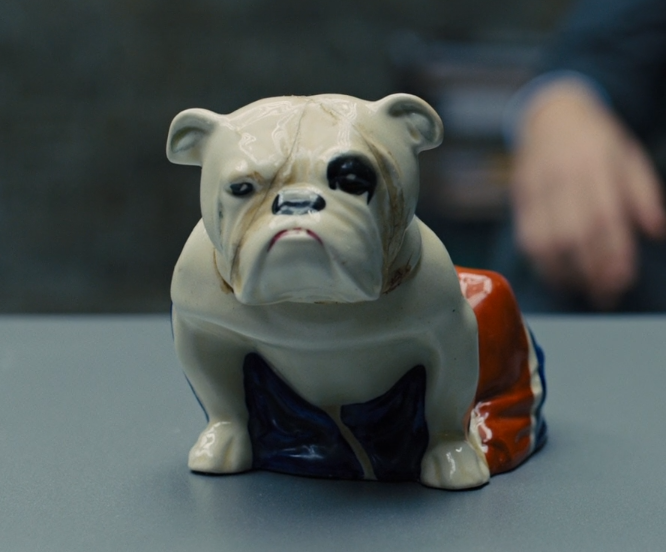
In several scenes, of the movie Skyfall from James Bond you can see a Royal Doulton china Bulldog on M's desk. At the beginning of the film on M's desk we see the small ceramic dog, to a casual watcher of the film this may seem completely irrelevant and insignificant, but this item reappears again and again throughout the movie. The bulldog is facing outward as if M is watching England at the start of the film, throughout the rest of the film the British bulldog is facing M, insinuating that England is watching M.

Also, in the first instance we see it, it is in a very quick reveal and we see it in the corner of our eyes on the desk. The symbolism of the dog is that its a British bulldog, which coincides with the general idea of the film being typically British. Furthermore, the British bulldog symbolizes the idea of 'for king and country' and with James Bond being a British spy it represents his promise to his country.
At the end of the film after M has passed away James Bond receives the same ceramic British bulldog as at the beginning of the film. This is a symbol as it represents Bond's duty to the country and that although M is gone the bulldog being passed along to James Bond could represent the passing of responsibility to the British spy.
This motif of a British bulldog represents pride and protection that James Bond provides the country with in his constant battle against the antagonist.
In several scenes, of the movie Skyfall from James Bond you can see a Royal Doulton china Bulldog on M's desk. At the beginning of the film on M's desk we see the small ceramic dog, to a casual watcher of the film this may seem completely irrelevant and insignificant, but this item reappears again and again throughout the movie. The bulldog is facing outward as if M is watching England at the start of the film, throughout the rest of the film the British bulldog is facing M, insinuating that England is watching M.

Also, in the first instance we see it, it is in a very quick reveal and we see it in the corner of our eyes on the desk. The symbolism of the dog is that its a British bulldog, which coincides with the general idea of the film being typically British. Furthermore, the British bulldog symbolizes the idea of 'for king and country' and with James Bond being a British spy it represents his promise to his country.
At the end of the film after M has passed away James Bond receives the same ceramic British bulldog as at the beginning of the film. This is a symbol as it represents Bond's duty to the country and that although M is gone the bulldog being passed along to James Bond could represent the passing of responsibility to the British spy.
This motif of a British bulldog represents pride and protection that James Bond provides the country with in his constant battle against the antagonist.
Sunday, 4 December 2016
Opening Sequence
What's the purpose of a film's opening sequence?
The opening of a film is vital in the film making process, it sets the scene and shows where the movie is being based. Furthermore, it often introduces the audience to a main star in the film, this is done to immediately captivate the viewer and encourage them to keep on watching.
Examples of different thriller opening sequences
The Usual Suspects -
Bryan Singer's 'The Usual Suspects' made in 1995 is a prime example of how the opening sequence is important. The audience immediately see a dead body which is significant as it makes the viewer ask questions, also a dead body gives connotations of violence and mystery. Due to the dead body being shown very early on in the film the audience instantly knows the movie is going to be dark and sinister. Also the use of eerie music adds to the atmosphere of the situation by building up tension, this ties in with the conventions of a typical thriller film. In addition the use of shadows in the first two minutes builds up a sense of mystery as the audience cannot see who the man is talking to posing questions as to what happens next.
Batman - The Dark Knight -
In Christopher Nolan's incredible masterpiece the opening scene really engages the audience with the theme and intensity of the film. The quiet music crescendos adding to the tense bank robbery scene also the clown masks show how sinister and dark the film is. Furthermore, how casually the killing is in the opening two minutes really shocks the audience as the viewer tries to understand why they are killing one another.
Fast and Furious 7 -
The seventh installment of Fast and Furious opens with a captivating one continuous take showing actor Jason Statham performing a monologue whilst standing over his hospitalized brother. This is extremely effective as it immediately presents us with the antagonist of the movie and his motive. Also the staggering amount of dead bodies in the shot adds to the idea that he will stop at nothing to avenge his brother.
Mad Max Fury Road opens with a monologue from the main character, this immediately imposes feelings of anguish and hatred as he talks about his world being made of fire and blood. His rough and beaten voice adds to this idea of a post apocalyptic land. Through his monologue you can hear gunshots and death suggesting the cruel world he lives in and gives a background to the film very early on. All the audience see for the first thirty seconds of the film is a black screen, this is extremely effective as it makes the viewer focus on the emotional speech by star actor Tom Hardy making the viewer anticipate and create a mental image of the world he lives in.
The first scene is an establishing, wide shot in which a staggering and incredible landscape is shown displaying the vast,baron wasteland described by Max in his monologue. The seemingly bright and orange setting is almost interrupted by a dark looming cloud foreshadowing danger which occurs a few moments later. Furthermore, the way the man stands tall looking out across and into the distance could symbolize that he is a beacon of hope for the destroyed world.
When the monologue picks up again the focus turns to a small lizard which the character stamps on and eats, this symbolizes the harsh, cruel and brutal world the film is set in. Also, the importance of this is too show the current situation the character is in as he looks scarred,bruised and beaten. The characters monologue talks about the voices in his head, displaying to the audience his weakness very early on and showing how he is mildly schizophrenic and mentally unstable.
The voices of young children suggests he has lost people close to him or that he feels guilty for something. This again gives us an incite on the kind of man he is, that although he seems tough and resilient he is still human. Also when he kills the lizard the voices stop which signifies he is shutting them out and that they haunt him.
The use of the extreme close up on the characters face shows he is beaten and cut but also makes the audience feel more connected as his face is revealed and his identity is released. The scene then shows the character being chased by five or six other cars as we hear the loud engines roar and the shouts and screams of the pursuers. These screams rather than being of fear are ones of happiness and eagerness and makes the chasers seem animalistic. Instantly we see a difference between the main character and the ones in pursuit, as the audience establish the antagonist and protagonist roles.
The opening of a film is vital in the film making process, it sets the scene and shows where the movie is being based. Furthermore, it often introduces the audience to a main star in the film, this is done to immediately captivate the viewer and encourage them to keep on watching.
Examples of different thriller opening sequences
The Usual Suspects -
Bryan Singer's 'The Usual Suspects' made in 1995 is a prime example of how the opening sequence is important. The audience immediately see a dead body which is significant as it makes the viewer ask questions, also a dead body gives connotations of violence and mystery. Due to the dead body being shown very early on in the film the audience instantly knows the movie is going to be dark and sinister. Also the use of eerie music adds to the atmosphere of the situation by building up tension, this ties in with the conventions of a typical thriller film. In addition the use of shadows in the first two minutes builds up a sense of mystery as the audience cannot see who the man is talking to posing questions as to what happens next.
Batman - The Dark Knight -
In Christopher Nolan's incredible masterpiece the opening scene really engages the audience with the theme and intensity of the film. The quiet music crescendos adding to the tense bank robbery scene also the clown masks show how sinister and dark the film is. Furthermore, how casually the killing is in the opening two minutes really shocks the audience as the viewer tries to understand why they are killing one another.
Fast and Furious 7 -
The seventh installment of Fast and Furious opens with a captivating one continuous take showing actor Jason Statham performing a monologue whilst standing over his hospitalized brother. This is extremely effective as it immediately presents us with the antagonist of the movie and his motive. Also the staggering amount of dead bodies in the shot adds to the idea that he will stop at nothing to avenge his brother.
Mad Max Fury Road opens with a monologue from the main character, this immediately imposes feelings of anguish and hatred as he talks about his world being made of fire and blood. His rough and beaten voice adds to this idea of a post apocalyptic land. Through his monologue you can hear gunshots and death suggesting the cruel world he lives in and gives a background to the film very early on. All the audience see for the first thirty seconds of the film is a black screen, this is extremely effective as it makes the viewer focus on the emotional speech by star actor Tom Hardy making the viewer anticipate and create a mental image of the world he lives in.
The first scene is an establishing, wide shot in which a staggering and incredible landscape is shown displaying the vast,baron wasteland described by Max in his monologue. The seemingly bright and orange setting is almost interrupted by a dark looming cloud foreshadowing danger which occurs a few moments later. Furthermore, the way the man stands tall looking out across and into the distance could symbolize that he is a beacon of hope for the destroyed world.
When the monologue picks up again the focus turns to a small lizard which the character stamps on and eats, this symbolizes the harsh, cruel and brutal world the film is set in. Also, the importance of this is too show the current situation the character is in as he looks scarred,bruised and beaten. The characters monologue talks about the voices in his head, displaying to the audience his weakness very early on and showing how he is mildly schizophrenic and mentally unstable.
The voices of young children suggests he has lost people close to him or that he feels guilty for something. This again gives us an incite on the kind of man he is, that although he seems tough and resilient he is still human. Also when he kills the lizard the voices stop which signifies he is shutting them out and that they haunt him.
The use of the extreme close up on the characters face shows he is beaten and cut but also makes the audience feel more connected as his face is revealed and his identity is released. The scene then shows the character being chased by five or six other cars as we hear the loud engines roar and the shouts and screams of the pursuers. These screams rather than being of fear are ones of happiness and eagerness and makes the chasers seem animalistic. Instantly we see a difference between the main character and the ones in pursuit, as the audience establish the antagonist and protagonist roles.
Monday, 28 November 2016
Tuesday, 8 November 2016
Thursday, 8 September 2016
Subscribe to:
Posts (Atom)